
INDUSTRIAL ACTIVATED CARBON TOWER FOR VOC CONTROL / PAINT EXTRACTION
request a quote
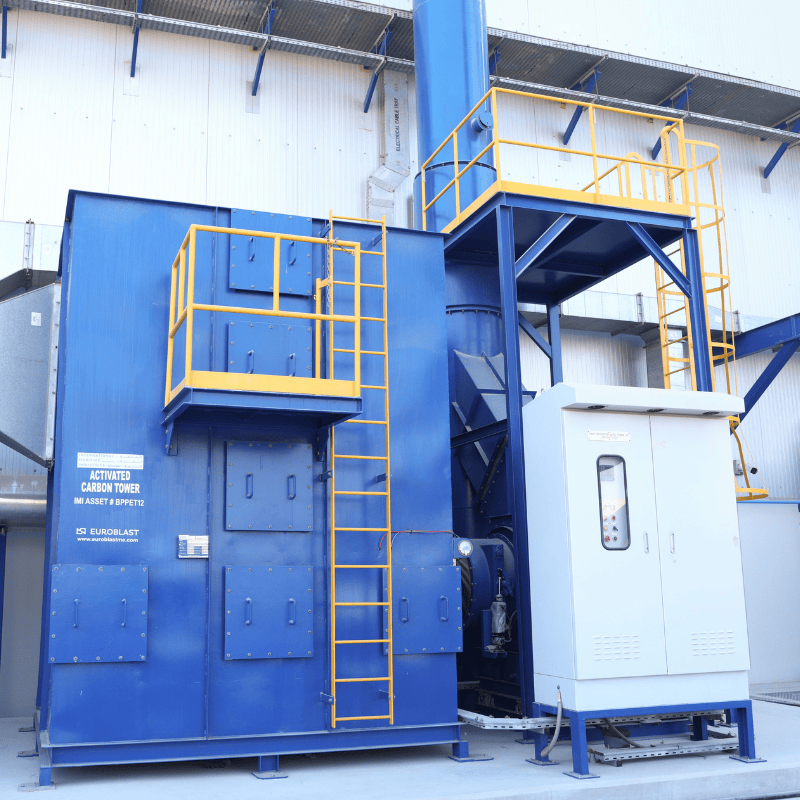
INDUSTRIAL ACTIVATED CARBON TOWER FOR VOC CONTROL / PAINT EXTRACTION
Paint Extraction is designed for extracting the paint mist and Volatile Organic Compound (VOC)from inside the Painting Room and to be filtered and absorbed in the Activated Carbon Tower for odorless and clean air discharging. This process is protecting the health of the worker from inhaling harmful chemicals and prevents the accumulation of dangerous fumes from creating fire or explosions.
The inside wall of the Painting Room is installed with a primary filter, to extract the paint mist and VOC Paint Extraction Fan is installed to produce suction in the duct. When suction is carried out during painting the paint mist and VOC are extracted through the primary filter to trap the paint mist. In the primary filter, a gap is designed where the VOC will pass through the duct and delivered to the Activated Carbon Tower. In the Activated Carbon Tower, carbon charcoal is set to purify the air from odor and VOC. The Activated Carbon Tower purifies the air in three stages of compartment and releases the clean air into the atmosphere.
The paint extraction fan normally used is centrifugal type and the capacity of the fan is estimated based on the room volume, and velocity considering the local administration regulations of required air-change / air velocity Activated Carbon Tower – Paint Fume Extraction System
- Purpose & Function
An Activated Carbon Tower is used as a secondary air-cleaning system in industrial paint rooms. It removes volatile organic compounds (VOCs), solvent vapors, paint fumes, and odors generated during spray painting before air is discharged to atmosphere. The system ensures environmental compliance, odor control, and operator safety.
- Working Principle
The system works on physical adsorption. Contaminated air, after passing through primary paint arrestor filters, enters the activated carbon bed. VOC molecules are trapped within the porous structure of the activated carbon, and treated air is exhausted safely.
- System Configuration
- Heavy-duty steel housing
- Granular activated carbon bed
- Uniform air distribution screens
- Access doors for maintenance
- Differential pressure monitoring ports
- Sampling ports for emission testing
- Activated Carbon Specification
- Granular Activated Carbon (GAC)
- Coconut shell or coal-based
- Iodine number ≥ 900–1100 mg/g
- Suitable for xylene, toluene, MEK, paint thinners
- Design Considerations
- Airflow capacity (m³/hr)
- VOC concentration
- Solvent type
- Contact time
- Local environmental regulations
- Ambient temperature and humidity
- Safety & Compliance
- Installed after particulate filters
- Anti-static grounding
- Fire-retardant construction
- Complies with environmental and occupational safety norms
- Maintenance & Operation
- No moving parts
- Periodic pressure drop monitoring
- Carbon replacement based on usage (typically 6–18 months)
- Spent carbon disposed as per regulations
- Advantages
- High VOC removal efficiency
- Compact design
- Silent operation
- Easy integration with paint room exhaust systems
- Applications
- Industrial paint rooms
- Shipyards
- Heavy fabrication shops
- Automotive and equipment painting facilities
technical specifications
| TECHNICAL DATA | ACTIVATED CARBON TOWER | ||
| Description | Unit | Specification | |
| 2 | Type/Mode | Activated Carbon Tower (EB-ACT 1000-122) | |
| 3 | Clearing Away (Adsorption Material) | ACTIVATED CARBON (4×8 Mesh) | |
| 4 | Media | Air + Paint fumes | |
| 5 | Disposal Air Flow | m³/min | 500 /1000 / 1500 /2000m³/min ( Depends on design Requirement) |
| 6 | Absorption Speed | m/s | 0.5m/s m³/min |
| 7 | Absorption Time | Sec | 1Sec |
| 8 | Bed Qty | 4 Stage | |
| 9 | Air Filter Specifications | ||
| 9.1 | Filter Type (Primary Filter) | HFL 2038 | |
| 9.2 | Material (Primary Filter) | 100% Polyester NON-WOVEN | |
| 9.3 | Particle Size (Activated Carbon) | % | 95% |
| 9.4 | Ash content (Activated Carbon) | % | 4.3 |
| 9.5 | Iodine Number (Activated Carbon) | mg/g | 953 |
| 9.6 | Surface area (Activated Carbon) | M2 | 988 |
| 9.7 | Apparent Density (Activated Carbon) | g/m2 | 0.48 |
| 9.8 | Moisture (Activated Carbon) | % | 3.5 |
| 9.9 | Ball Pan Hardness (Activated Carbon) | % | 98 |
| 9.10 | Ph (Activated Carbon) | 8 | |
| 10 | Compressed Air requirement | Kg/sq.cm | 6-7 Kg/Sq.CM |
| 11 | Manometer | mm.Aq | 0~300 mm.Aq |
| 12 | Driving Method: | Electrical motor with fan blower | |
| 12.1 | Motor Power | 75kW ,400VAC, 4P, 3PH, 60Hz | |
| 12.2 | Fan Blower | 1000 m3 /min | |
| 12.3 | Pressure Loss | mm.Aq | 200 mm.Aq |
| 13 | Starting Method | Soft Starter | |
| 14 | Maximum noise level | db | 88 |
| 15 | Protection Degree | IP | IP55 |
| 16 | Weight | Ton | 20 Ton |